Scientific Proof

The Evidence Is Overwhelming

From physical lunar samples to laser experiments still running today — the proof that humans walked on the Moon comes from multiple, independent, verifiable sources.

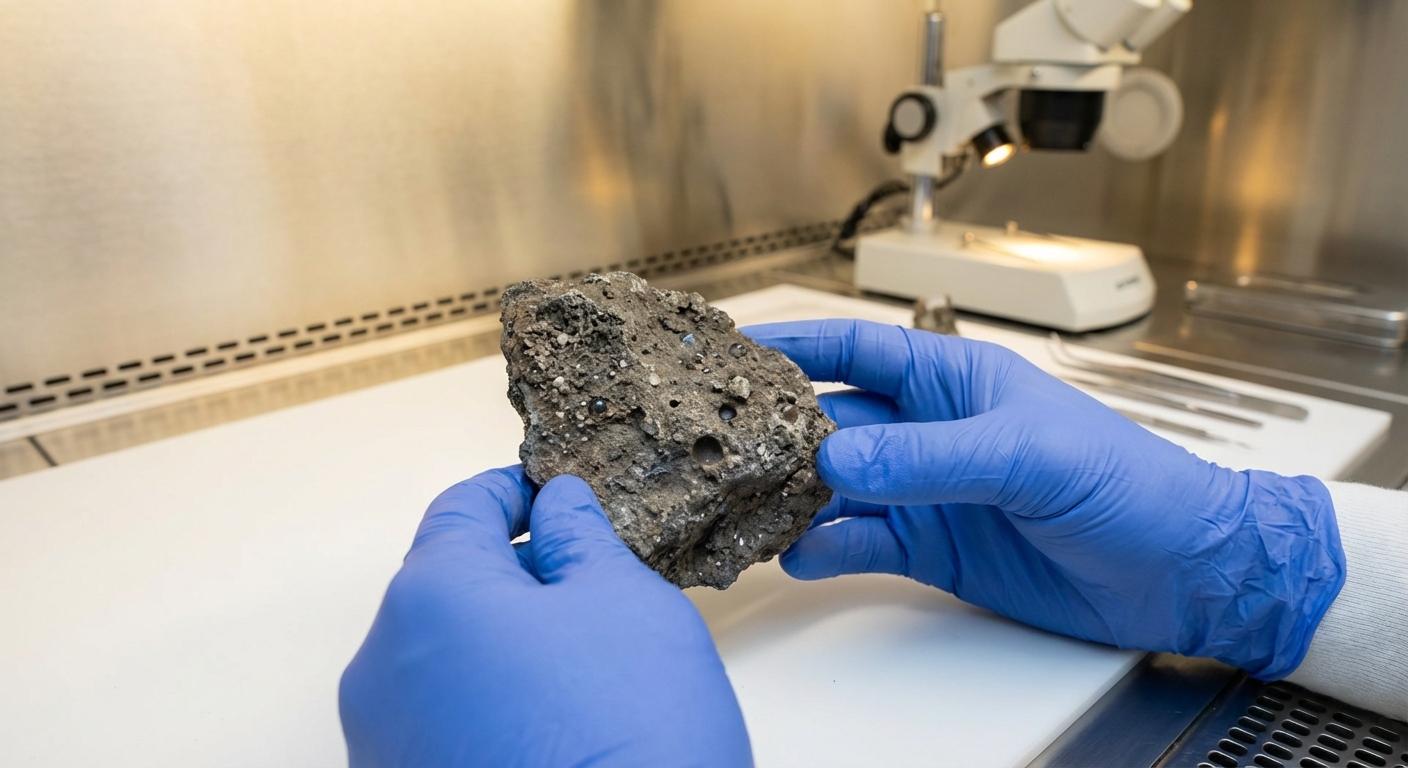
Lunar rock sample being studied under laboratory conditions, showing the unique crystalline structure of regolith

 382 Kilograms of Moon Rock

The Apollo missions brought back 2,415 individual samples totaling 382 kilograms of lunar material. These rocks have been independently analyzed by scientists in laboratories across more than 40 countries.

Key findings that prove their lunar origin:

  • No water content: Unlike any Earth rock, lunar samples contain virtually no hydrated minerals — consistent with the Moon's airless environment
  • Micrometeorite impacts: Tiny craters caused by cosmic particles are embedded in the rock surfaces — impossible to fake without a vacuum exposure lasting millions of years
  • Solar wind particles: Noble gases from the solar wind are implanted in the outer layers, a signature that can only form on an airless body
  • Unique isotope ratios: Oxygen isotope ratios match the Earth-Moon system but differ from all meteorites, confirming a shared formation history
  • Soviet validation: Samples match those returned by the USSR's robotic Luna missions — independent confirmation from America's Cold War rival
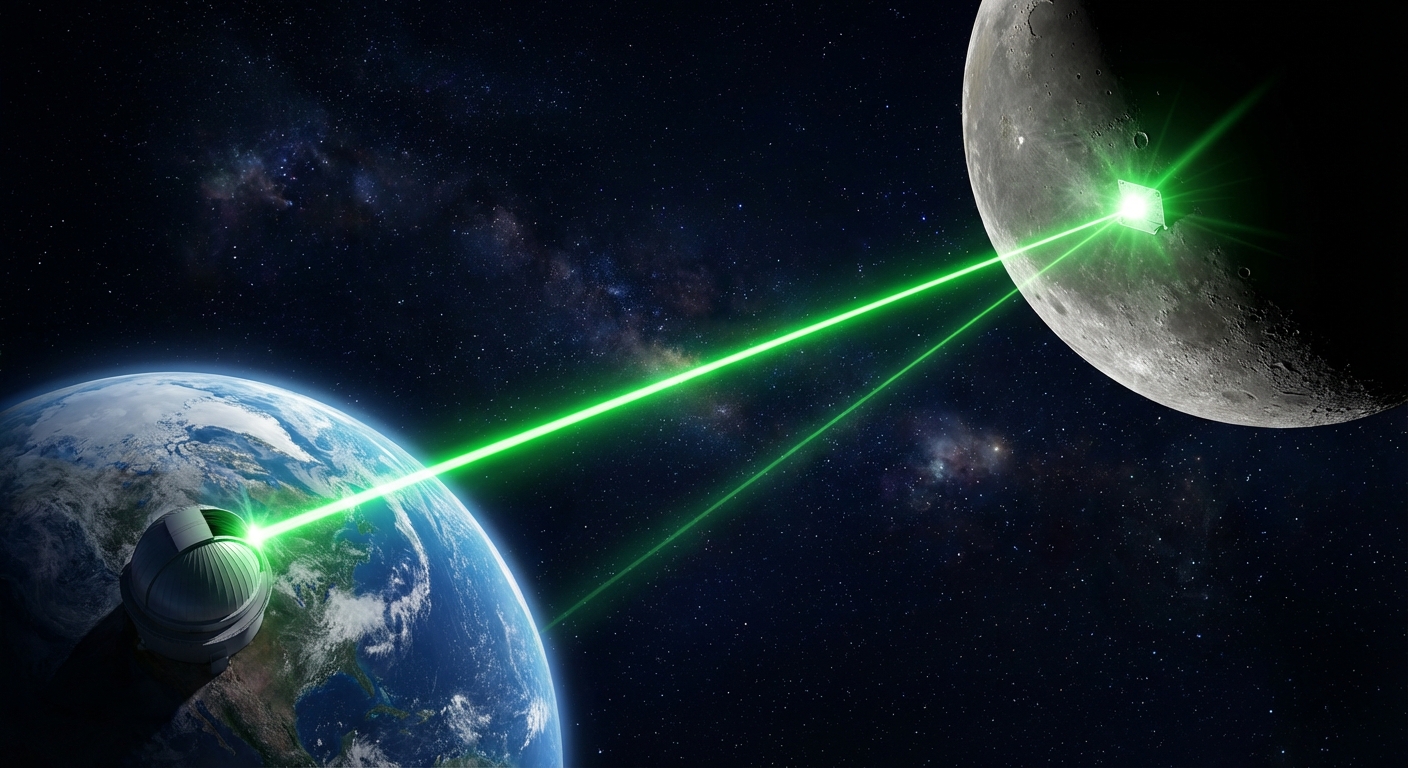
Illustration of a laser beam bouncing off a retroreflector on the lunar surface, showing the Earth in the background

 Laser Ranging Retroreflectors

Apollo 11, 14, and 15 each placed retroreflector arrays on the Moon's surface. These arrays are still used daily by observatories around the world.

Here's how they work and why they matter:

  • Active experiment: Scientists fire powerful lasers at the reflectors and measure the return signal — proving the devices are physically on the Moon
  • Millimeter precision: These measurements have determined the Earth–Moon distance to within a few millimeters
  • Global use: Observatories in the US, France, Germany, Italy, and Australia regularly perform these experiments
  • Key discovery: Laser ranging proved the Moon is slowly moving away from Earth at 3.8 cm per year
  • Cannot be natural: Retroreflectors are precision-engineered optical devices — they could only be placed by a mission

Photographed by Other Nations

Multiple countries have independently sent spacecraft to orbit the Moon and photographed the Apollo landing sites.

NASA's LRO (2009–present)

The Lunar Reconnaissance Orbiter has captured stunning high-resolution images of all six Apollo landing sites, clearly showing the descent stages of the lunar modules, scientific instruments, rovers, and even the footpaths left by astronauts in the lunar soil.

Japan's SELENE / Kaguya (2007)

Japan's SELENE orbiter (nicknamed Kaguya) photographed the Apollo 15 landing site. Its terrain camera captured a "halo" in the regolith at the exact location where the lunar module engine disturbed the surface — matching NASA records precisely.

China's Chang'e Missions

China's lunar program has independently confirmed the composition and characteristics of the lunar surface as documented by Apollo. China has never disputed the landings — their own data validates the American findings.

India's Chandrayaan (2008)

India's Chandrayaan-1 orbiter mapped the lunar surface and its findings aligned perfectly with decades of Apollo-era science. India's space agency ISRO has publicly affirmed the reality of the Apollo missions.

Tracked in Real Time by Rivals

The Apollo missions were independently tracked by countries around the world — including the Soviet Union.

Soviet Tracking

The USSR had deep space tracking stations that monitored the Apollo missions. If the signals had come from Earth orbit instead of the Moon, Soviet scientists would have immediately detected the deception and exposed it — during the height of the Cold War.

Australian Tracking

The CSIRO Parkes radio telescope in Australia received the live television signal from Apollo 11's moonwalk and relayed it to the world. The signal characteristics were consistent only with a transmission from the Moon, not from Earth orbit.

Worldwide Radio Amateurs

Independent ham radio operators around the world picked up Apollo communications. They could track the signal source moving away from Earth toward the Moon — a trajectory impossible to fake with 1960s technology.

"The best thing I can say about conspiracy theories is that we went to the Moon nine times. If we faked it, why did we fake it nine times?"
— Jim Lovell, Apollo 13 Commander

Explore All Six Landing Missions

See the timeline of every Apollo mission that reached the Moon, from Apollo 11 to Apollo 17.

 View Missions